

Why UV Rejection Matters for Luxury Cars
Most luxury car owners assume their factory glass provides adequate UV protection. That assumption is costly. Understanding why UV rejection matters in luxury cars starts with one fact: standard tempered side windows transmit a significant portion of UVA radiation directly into the cabin. Your Lamborghini’s Alcantara, your Ferrari’s leather, your Porsche’s wood veneer — all of it degrades under that exposure. So does your skin. The good news is that advanced UV rejection technologies exist specifically for high-end vehicles, and choosing the right solution protects both your investment and your health.
Table of Contents
- Key takeaways
- How UV radiation damages luxury car interiors and occupants
- Factory glass UV protection: what it actually covers
- Advanced UV rejection technologies for luxury vehicles
- Practical steps for protecting your vehicle and health
- Long-term benefits of UV rejection in luxury cars
- My perspective on UV rejection in luxury vehicles
- Upgrade your luxury vehicle with Playersclubcars
- FAQ
Key takeaways
| Point | Details |
|---|---|
| Factory glass is not enough | Tempered side windows transmit 50-70% of UVA, leaving interiors and occupants exposed. |
| Interior damage is fast | Luxury materials show noticeable fading within 6-18 months without UV protection in place. |
| Ceramic films outperform all alternatives | Premium ceramic window films block up to 99.9% of UVA and UVB without signal interference. |
| Health risk is real | UVA through side windows causes unilateral skin photoaging and raises melanoma risk for drivers. |
| Certification matters | Look for films certified to ISO 21348 and carrying the Skin Cancer Foundation’s Seal of Recommendation. |
How UV radiation damages luxury car interiors and occupants
UV radiation splits into two categories that behave very differently inside a vehicle. UVB rays are shorter wavelength and largely blocked by standard glass. UVA rays are longer wavelength, more penetrating, and far more difficult to stop without a dedicated interlayer or film.
Inside a luxury cabin, UVA exposure triggers photodegradation. That is a photochemical breakdown of molecular bonds in dyes, leather, and synthetic materials. The process is invisible at first. Then, within months, you see it.
- Leather seats develop uneven fading and surface cracking along sun-exposed panels
- Alcantara and fabric headliners lose color saturation and fiber integrity
- Wood veneers and carbon fiber trim develop surface oxidation and finish dulling
- Dashboard polymers become brittle and prone to cracking at stress points
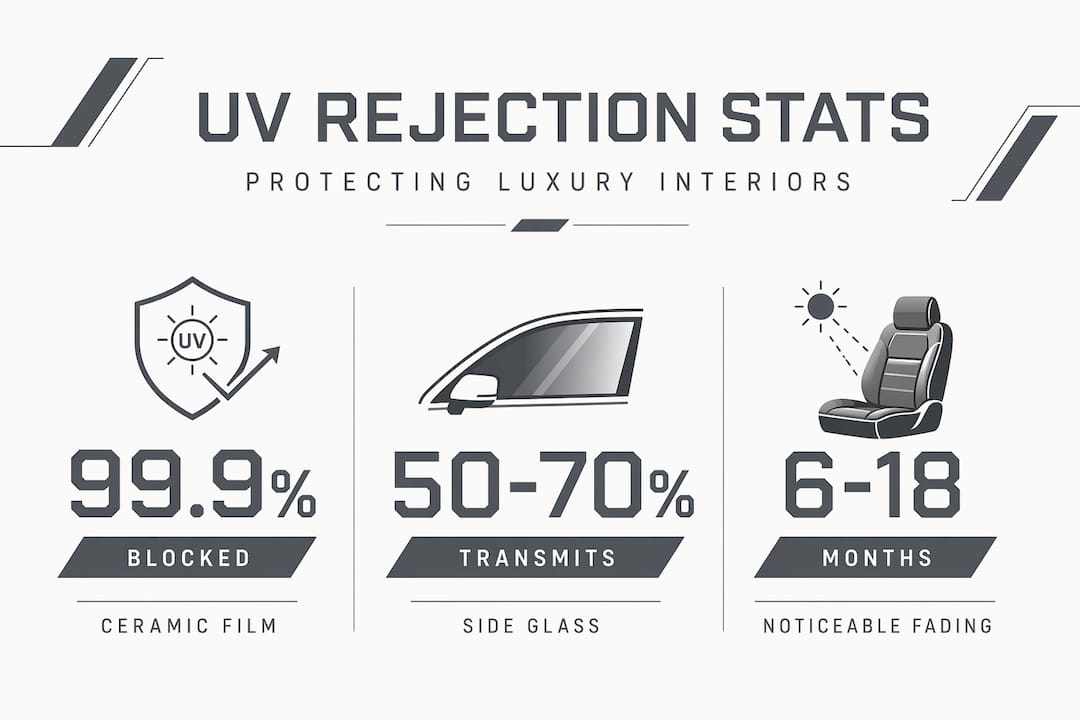
Fading from UVA is an irreversible photochemical breakdown that manifests visibly within 6 to 18 months, and reaches significant structural degradation by year three. For a vehicle where interior condition directly affects resale value, that timeline is unacceptable.
The health implications are equally direct. UVA rays through side windows cause unilateral skin photoaging and increase melanoma risk for drivers. Clinical data shows higher rates of left-sided facial sun damage in drivers, correlating to years of commute and highway exposure. The absence of sunburn sensation is part of the problem. Many drivers underestimate UVA exposure inside cars precisely because UVA does not cause the immediate redness that UVB does, allowing cumulative damage to accumulate unnoticed over years.
UVA is the most insidious form of UV radiation. It penetrates deeper, causes photoaging, and often goes unnoticed because it produces no sunburn sensation — making it a silent threat for daily drivers.
Factory glass UV protection: what it actually covers
There is a clear and important distinction between your windshield and your side windows. Most drivers treat all factory glass as equivalent. It is not.
| Glass type | UV blocking level | Notes |
|---|---|---|
| Laminated windshield | 95-99% UVA, ~100% UVB | PVB interlayer absorbs UV effectively |
| Tempered side windows | 30-50% UVA, ~100% UVB | No interlayer; significant UVA transmission |
| Tempered rear window | 30-50% UVA, ~100% UVB | Same limitation as side glass |
| Laminated side windows (OEM) | 90-98% UVA | Available in select luxury and EV trims |
Standard laminated windshields block 95 to 99% of UVA and nearly 100% of UVB, providing strong front protection. The windshield’s polyvinyl butyral (PVB) interlayer is specifically engineered to absorb UV radiation. Tempered glass used in side and rear windows has no such interlayer.
Tempered side and rear windows typically transmit 50 to 70% of UVA radiation. That figure applies to the majority of vehicles on the road, including many luxury models. Factory tint adds a visual darkening effect but does not meaningfully change UV transmission. This is one of the most common misconceptions among luxury car owners: dark tint does not equal UV rejection.
Some OEM manufacturers are increasing the use of laminated side windows, particularly in premium trims and EV models. Tesla, Volvo, and Genesis offer laminated side glass on select configurations, blocking 90 to 98% of UVA. However, this remains limited to specific models and trim levels. The majority of luxury vehicles still rely on tempered side glass, making aftermarket UV rejection solutions relevant for most owners.
Advanced UV rejection technologies for luxury vehicles
The aftermarket window film market has advanced considerably. Not all films deliver the same performance, and the differences matter for high-end vehicle owners who prioritize both protection and aesthetics.
| Film type | UV rejection | Heat rejection | Signal interference | Longevity |
|---|---|---|---|---|
| Dyed film | 60-85% | Low | None | 2-4 years |
| Metallic film | 80-95% | Moderate | Yes (GPS, cellular) | 5-8 years |
| Carbon film | 90-99% | Moderate-high | Minimal | 8-10 years |
| Ceramic film | Up to 99.9% | High | None | 10+ years |
Premium ceramic window films block up to 99.9% of harmful UVA and UVB rays while maintaining optical clarity and rejecting significant infrared heat. They use nano-ceramic particles suspended in a non-metallic matrix, which means no interference with GPS, radar detectors, or cellular signals. For a Porsche 911 or Mercedes-AMG GT loaded with driver assistance electronics, that matters.
Dyed films degrade after 2 to 4 years and metallic films interfere with GPS and phone signals. Neither is appropriate for a vehicle where technology integration and long-term performance are priorities. Ceramic films maintain UV rejection longer and do not compromise vehicle electronics.
Optical clarity is a separate performance metric that luxury car owners should evaluate independently. Ultra-low haze nano-ceramic films preserve sharp views and minimize distortion, which matters especially for panoramic roofs and large side glass found on vehicles like the Lamborghini Urus or Porsche Cayenne Turbo GT.
Professional ceramic films certified to ASTM D1003 for optical clarity and ISO 21348 for UV transmission provide greater than 99% UVA and UVB rejection with negligible haze. These certifications are the standard to verify before any installation.
Pro Tip: Ask your installer for the specific film’s technical data sheet showing ISO 21348 UV transmission results. Any reputable ceramic film brand will provide this documentation. If they cannot, select a different product.
Practical steps for protecting your vehicle and health
Taking action on UV rejection does not require guesswork. There is a clear process for evaluating your current situation and selecting the right solution.
- Identify your glass type. Check your vehicle’s specifications or contact the manufacturer to confirm whether your side windows use laminated or tempered glass. This determines your baseline UV exposure.
- Request UV transmission data. If your vehicle uses tempered side glass, assume significant UVA transmission and treat it as unprotected.
- Select a certified ceramic film. Look for products carrying the Skin Cancer Foundation’s Seal of Recommendation, which requires 99% or greater UV protection. This is a verified consumer standard.
- Verify installer credentials. Choose an installer with documented experience on luxury vehicles. Improper installation on curved or large glass panels introduces bubbling, lifting, and optical distortion.
- Request post-installation verification. A UV meter reading before and after installation confirms actual rejection performance. This is standard practice for professional installers working on high-value vehicles.
- Maintain the film properly. Avoid ammonia-based cleaners, which degrade film adhesive. Use pH-neutral cleaners and microfiber cloths on all treated surfaces.
Pro Tip: Schedule window film installation before taking delivery of a new vehicle if possible. Applying film to a vehicle with zero interior UV exposure preserves the factory condition from day one.
Beyond film installation, behavioral adjustments add a layer of protection. Broad-spectrum sunscreen applied to the left arm and left side of the face is relevant for daily drivers. UV-blocking driving gloves address hand exposure that most people overlook entirely.
Long-term benefits of UV rejection in luxury cars
The return on UV rejection investment is measurable across several categories.
- Interior preservation. Preventing photodegradation keeps leather supple, colors accurate, and trim surfaces intact. This directly reduces detailing and restoration costs over the vehicle’s life.
- Resale value. Interior condition is a primary factor in luxury vehicle appraisals. A cabin that shows UV fading, cracked leather, or oxidized trim commands a lower price regardless of mechanical condition.
- Cabin comfort. Ceramic films reject significant infrared heat alongside UV radiation. Reduced heat load means lower cabin temperatures when parked, less reliance on air conditioning, and a more consistent driving environment.
- Occupant health. Consistent UV rejection reduces cumulative UVA exposure for drivers who spend significant time behind the wheel. This is a long-term health consideration, not an immediate one.
- Film durability. Quality ceramic films maintain performance for 10 or more years with proper care, making the cost per year of protection modest relative to the value of the vehicle and its interior.
The importance of UV rejection compounds over time. A vehicle protected from year one retains its interior integrity far longer than one where protection is added after visible damage has already occurred.
My perspective on UV rejection in luxury vehicles
I’ve worked with luxury car owners long enough to recognize a consistent pattern. UV protection is treated as optional until the damage is visible. By that point, the leather is already fading unevenly, the Alcantara is losing its texture, and the resale conversation becomes uncomfortable.
What I’ve found is that most owners focus on exterior protection. Paint protection film, ceramic coatings, careful washing protocols. The interior gets far less attention, despite spending more time in direct UV contact during every drive.
The side window issue is the one that surprises people most. Owners of a $300,000 Ferrari or a $250,000 Lamborghini assume the factory glass is engineered to the same standard as everything else in the vehicle. It is not. Tempered side glass is a structural choice, not a UV protection choice. The windshield blocks UV well. The doors do not.
What I’ve also observed is that optical clarity concerns stop some owners from pursuing film. They worry about distortion or a visible tint line. That concern is valid for low-grade films. It is not valid for properly certified nano-ceramic products installed by a qualified technician. The technology has advanced to the point where the film is functionally invisible while delivering protection the factory glass cannot match.
The practical position is straightforward: UV rejection is a performance specification, the same as brake performance or suspension calibration. Treat it that way.
— Players Club Cars
Upgrade your luxury vehicle with Playersclubcars
Playersclubcars specializes in custom carbon fiber and performance components for Ferrari, Lamborghini, Mercedes-AMG, Porsche, and Hummer EV. Protecting your vehicle’s interior from UV degradation is one part of a broader approach to preserving aesthetics and performance. The other part is upgrading the components that define how the vehicle looks and performs.
Explore the carbon fiber rear wing for the Lamborghini Huracán STO, engineered for both aerodynamic performance and visual precision. For interior upgrades that complement a well-protected cabin, the carbon fiber sport seats for the Huracán STO combine weight reduction with a factory-quality finish. Browse the full Lamborghini parts collection for the complete range of available upgrades.
FAQ
Do factory-tinted windows block UV rays?
Factory tint adds visual darkening but does not significantly reduce UVA transmission. Tempered side windows with factory tint still transmit a substantial portion of UVA radiation.
What type of window film provides the best UV rejection?
Premium ceramic window films provide the highest UV rejection, blocking up to 99.9% of UVA and UVB rays without interfering with vehicle electronics or GPS signals.
How quickly does UV exposure damage luxury car interiors?
Without UV protection, luxury interior materials show noticeable fading within 6 to 18 months and significant material degradation by year three.
Is UV exposure through car windows a health risk?
Yes. UVA rays penetrate side windows and cause unilateral skin photoaging and increased melanoma risk. Clinical data links left-sided facial sun damage to long-term driving exposure.
What certifications should I look for in a UV-rejecting window film?
Look for films certified to ISO 21348 for UV transmission and ASTM D1003 for optical clarity. The Skin Cancer Foundation’s Seal of Recommendation requires 99% or greater UV protection and is a reliable consumer benchmark.